

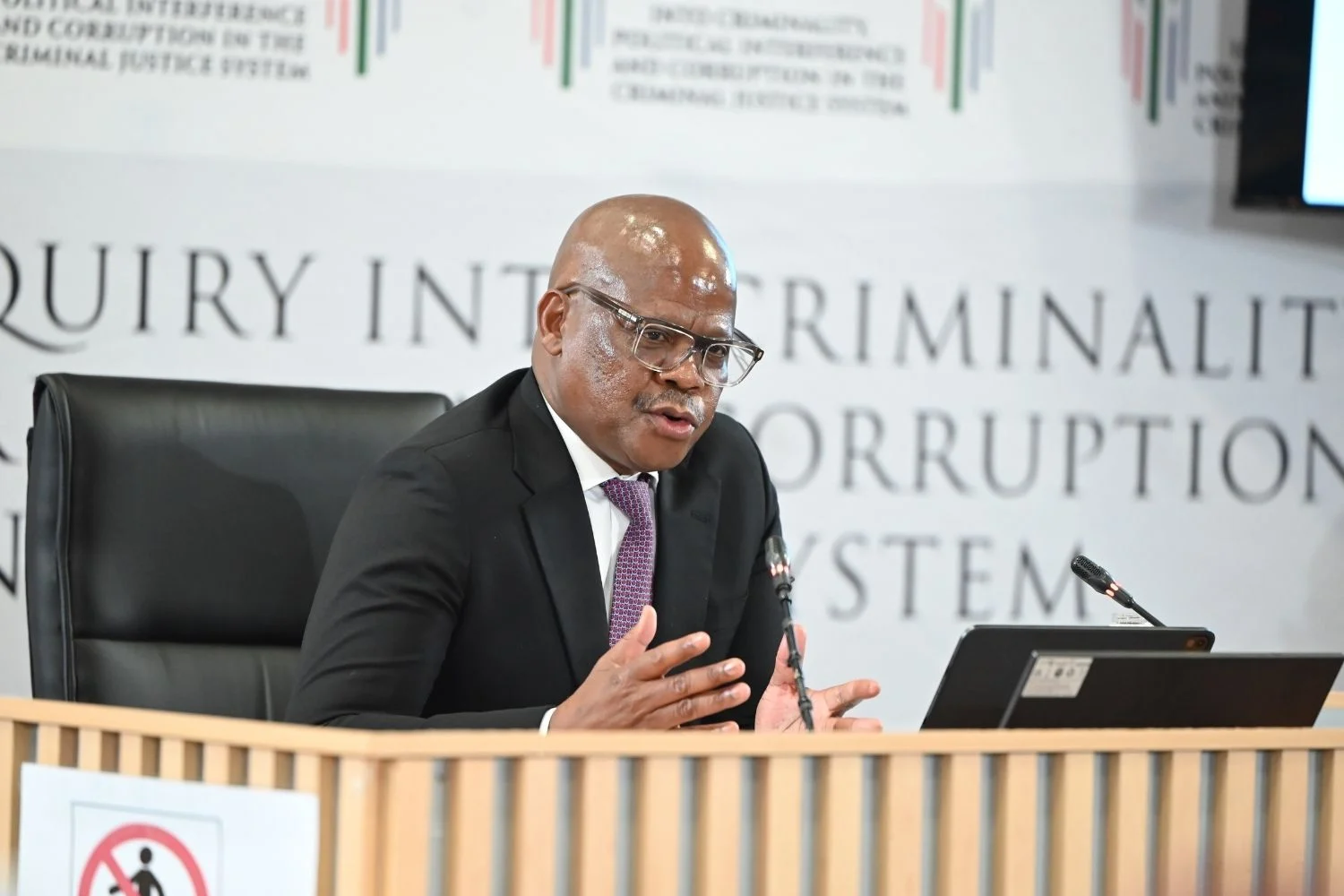
Mpumalanga taxi boss and businessman Joe “Ferrari” Sibanyoni spent much of Tuesday, 29 September, back in the witness chair at the Madlanga Commission of Inquiry, where evidence leaders questioned him about his relationship with businessman Dr Tengane Thomas Ntuli, payments linked to the Moloto Road project, alleged protection fees and money paid towards the legal defence of men convicted of taxi-related murders.
Sibanyoni rejected allegations that he was involved in an extortion racket, maintaining that his dealings with Ntuli were part of a legitimate business arrangement.
However, evidence leaders repeatedly challenged his explanations about the flow of money, the structure of the partnership and his relationship with taxi boss Oupa “Bafana” Sindane.
The questioning followed evidence presented to the commission on Monday, when WhatsApp messages recovered from Sindane’s phone were used to argue that businessmen working on the Moloto Road project were being pressured to make payments to continue operating.
The Moloto Road deal
At the centre of Tuesday’s hearing was the business relationship between Sibanyoni and Ntuli.
Ntuli’s company, Tengane Mining, obtained a mining right and supplied aggregate stone to King Civil, the main contractor on part of the South African National Roads Agency’s Moloto Road project.
Ntuli has alleged that Sibanyoni and Sindane demanded payments from him after he became involved in the project.
Sibanyoni gave a different version.
He told the commission that Ntuli needed a local business partner to satisfy local-content requirements and that the two entered into a business arrangement.
“We started doing business,” Sibanyoni said.
He told the commission that he ultimately contributed R900,000 to the venture.
“I contributed R900,000 to the business and to him,” he said.
Sibanyoni said the arrangement initially involved a 50/50 profit split, but that it was later changed to 60% for Ntuli and 40% for him because Ntuli was responsible for running the quarry.
He insisted his 40% was a profit share rather than a protection fee.
“The understanding was him and me,” Sibanyoni told the commission, explaining that Ntuli had more experience operating the quarry and therefore received the larger share.
He also said the local-content component involved other businesses supplying trucks, equipment and labour.
The R100,000 payment under scrutiny
One of the most difficult moments for Sibanyoni came when evidence leader Advocate Matthew Chaskalson SC questioned him about a R100,000 payment made by Ntuli in July 2021.
Ntuli’s version is that Sibanyoni demanded R100,000 in cash during their first meeting and that the payment was connected to gaining permission to operate in the area.
His affidavit, as read at the commission, states: “I was told in order for me to operate in that area, I have to pay a protection fee.”
Ntuli further alleged that the arrangement meant his business would be left alone if he made the payments.
Sibanyoni rejected the allegation.
“No, it’s not true,” he said when asked whether he had demanded R100,000 from Ntuli.
But the payment records raised questions about the chronology of the relationship.
Sibanyoni initially described the R100,000 as the first profit from the business. He was then asked how that could have been the case when the payment was made in the same month he had first met Ntuli.
“I can’t explain it further,” Sibanyoni said, according to the Daily Maverick account of the proceedings.
He maintained that his recollection of the dates differed from Ntuli’s version.
Madlanga challenges the 40% explanation
The issue of the 40/60 split became another flashpoint.
Sibanyoni said the 40% represented his share of the profits and that the broader local-content arrangement was made up of different contributions from local businesses.
But Commission chairperson Justice Mbuyiseli Madlanga questioned whether Sibanyoni’s explanation was consistent.
Madlanga told him that the figures did not appear to add up and suggested that Sibanyoni appeared to be introducing the explanation of “40% of the 30%” to make sense of the earlier discussion.
“It sounds as though Mr Sibanyoni wants to push in the 40,” Madlanga said, according to Africa Daily’s account of the hearing.
Madlanga further said that talking about 60% and 40% of the 30% “does not make sense whatsoever”.
Sibanyoni did not accept that his explanation was dishonest.
When Madlanga asked whether he wanted to tell him that he was “talking nonsense”, Sibanyoni responded: “No, Chair, you’re not talking nonsense, with due respect.”
The alleged protection racket
The commission also returned to the allegations that payments made by Ntuli were not voluntary business payments but protection fees.
Evidence leader Chaskalson told the commission on Monday that the affidavits and WhatsApp messages pointed towards what he described as an extortion operation enforced through threats of violence.
“What we see in the affidavits of Ntuli and the chats is essentially an extortion racket enforced with threats of violence,” Chaskalson said.
According to evidence presented to the commission, messages allegedly sent by Sindane referred to payments of R100,000 and questioned why the amount had later been reduced.
One message allegedly demanded an explanation within 48 hours for why the operation should not be stopped.
Ntuli has told the commission that he believed he had to make the payments to keep his business operating.
Sibanyoni has denied being part of such an arrangement.
The criminal allegations are also before the Delmas court. Sibanyoni, Sindane and two other accused face charges including extortion and money laundering arising from Ntuli’s complaint, and they have denied the allegations.
The ‘new sheriff’ message
Another significant piece of evidence was a WhatsApp exchange concerning a proposed R500-million Moloto Road deal.
A message received by Sibanyoni referred to a director who had secured a R500-million deal and wanted to meet.
The message also referred to someone who had previously reported to “the farm” and now knew there was a “new sheriff in town”.
The commission has previously heard evidence about the alleged “farm” network associated with the late taxi industry figure Jotham “Mswazi” Msibi.
Sibanyoni has denied that he took over or controlled such a criminal network.
“I have succeeded as the leader of the taxi industry, which must be distinguished from leading the farm and wielding the power that flows from it,” he said in his statement to the commission.
When questioned about the R500-million message, Sibanyoni said the proposed transaction never materialised.
Commissioner Sandile Khumalo SC questioned why a director involved in such a large contract would seek a meeting with Sindane, particularly given Sibanyoni’s own evidence about the way payments were divided.
Sibanyoni maintained that he was not involved in any R500-million deal.
The legal fees for convicted killers
The hearing then moved into another contentious area – payments towards the legal defence of men convicted of taxi-related murders.
WhatsApp messages presented to the commission indicated that Sibanyoni and Sindane were involved in discussions about legal fees for two men, including Jabu “Gwabo” Mahlangu and Tshegofatso Richmond “Morwa” Makofane.
Evidence leader Chaskalson said the communications appeared to suggest that Sibanyoni and Sindane were involved in paying legal expenses.
“What these chats cumulatively suggest is that Sibanyoni and Sindane were involved in paying legal expenses,” Chaskalson said.
Sibanyoni admitted that a taxi association linked to him assisted with Mahlangu’s legal costs.
But he said the assistance was not because he supported the alleged crimes.
Instead, he told the commission that Mahlangu’s mother had approached him for help.
“His family, not Gwabo,” Sibanyoni said. “For example, his mother reached out to me.”
He said his involvement was about helping the family rather than personally supporting Mahlangu.
Commissioner Khumalo pointed out that, regardless of who requested the assistance, the money ultimately went towards Mahlangu’s legal representation while he faced a murder charge.
Sibanyoni acknowledged this.
Questions about taxi violence
The evidence around Mahlangu also led to questions about Sibanyoni’s knowledge of taxi-industry killings.
Chaskalson questioned Sibanyoni about messages concerning people allegedly connected to violent incidents.
Sibanyoni denied supporting people who killed taxi marshals.
Asked directly whether he supported such killings, Sibanyoni replied: “No, I don’t.”
He maintained that his involvement in the legal assistance was based on a request from Mahlangu’s family.
The evidence leaders, however, continued to question why an association connected to Sibanyoni would become involved in the legal defence of someone accused of a taxi-related murder.
Sibanyoni objects to the questioning
At several points during Tuesday’s proceedings, Sibanyoni objected to the manner in which he was being questioned.
He repeatedly referred to the criminal case pending in the Delmas court and argued that detailed questioning at the commission could prejudice his rights.
At one point, he told Chaskalson that he believed the commission should not effectively become the place where his criminal case was tried.
“If Mr Chaskalson is pushing this matter, that it must be heard here, it prejudices my rights,” Sibanyoni said.
He maintained that he intended to contest the criminal charges fully in court.
Chaskalson, meanwhile, pressed him on his evidence that he had never participated in unlawful activity while simultaneously seeking to avoid answering certain questions on the basis that they could incriminate him.
Madlanga also questioned why Sibanyoni could not simply deny Ntuli’s account if it was false.
What Tuesday revealed
Tuesday’s evidence placed three competing versions of the Moloto Road relationship before the commission.
Ntuli’s version is that payments were demanded as protection fees and that threats were used to ensure compliance.
The evidence leaders argued that the WhatsApp messages, payment records and affidavits were consistent with an alleged extortion racket.
Sibanyoni’s version is that he and Ntuli entered into a legitimate commercial arrangement, that he contributed R900,000 and that the money he received represented his share of profits or agreed business payments.
The commission also heard his explanations for assisting with the legal fees of men convicted of taxi-related murders, while evidence leaders questioned what those financial relationships indicated about his wider network.
None of these allegations amount to findings of guilt by the commission. The criminal allegations remain before the courts, while the Madlanga Commission is tasked with examining evidence relating to allegations of criminality, corruption and interference within the criminal justice system.
Sibanyoni’s cross-examination is expected to continue as the commission further tests his account against documentary evidence, financial records, WhatsApp messages and testimony from other witnesses.
