

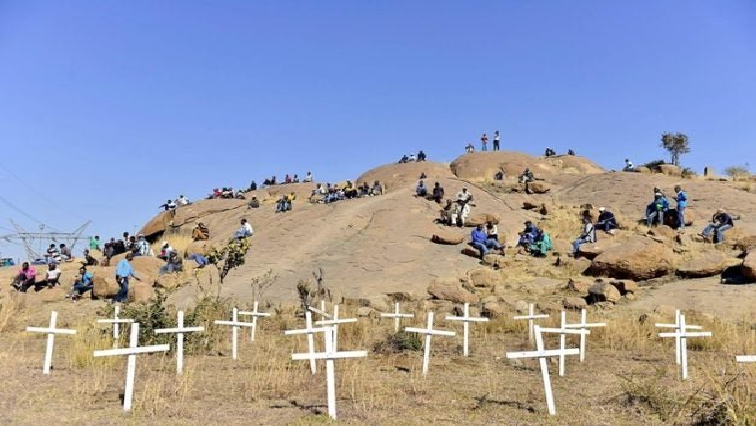
Fourteen years after police opened fire on striking mineworkers at Marikana, the events of 16 August 2012 remain one of the darkest chapters in democratic South Africa’s history, with survivors and families of those killed continuing to demand accountability, reparations and an acknowledgement from the state of the suffering they endured.
Today, 16 August 2026, the Association of Mineworkers and Construction Union (AMCU) will hold a commemorative event in Marikana, near Rustenburg, to mark the anniversary of the massacre. AMCU president Joseph Mathunjwa is expected to address workers, survivors, families and supporters as the community once again gathers at the site where 34 mineworkers were killed.
The massacre followed a wage dispute at Lonmin’s platinum operations in Marikana. The striking rock-drill operators were demanding a monthly wage of R12,500, a figure that became the defining symbol of the strike and later of the wider struggle over wages, living conditions and dignity in South Africa’s mining industry.
The dispute began in August 2012 amid deep tensions between mineworkers, Lonmin management and competing trade unions, particularly the National Union of Mineworkers (NUM) and the emerging AMCU. Workers embarked on an unprotected strike, with many saying they had lost confidence in the existing bargaining structures and wanted their wage demands taken directly to the employer.
What followed was a week of escalating violence before the bloodshed of 16 August.
At least 10 people were killed in strike-related violence between 12 and 14 August, including two police officers, two Lonmin security guards and several mineworkers. The Marikana Commission of Inquiry examined the deaths and events surrounding the strike from about 11 to 16 August, ultimately recording about 44 deaths connected to the period under investigation, with more than 70 people injured and about 250 arrested.
The violence began before the police shootings. On 12 August, two Lonmin security guards, Hassan Fundi and Frans Mabelane, were killed after a confrontation with striking workers. Other mine employees were also killed or injured during the escalating unrest. On 13 August, two police officers were killed during a confrontation with striking workers, while three mineworkers were killed in the subsequent police response.
These deaths created an increasingly volatile environment, with police deploying large numbers of officers and armoured vehicles around the workers who had gathered on a koppie near the mine. The following day, on 14 August, Lonmin and AMCU reached an agreement recognising AMCU as the majority union at the mine, but the central wage dispute remained unresolved.
On 16 August, thousands of workers gathered at the koppie. Police had prepared an operation to disperse them, initially involving an encirclement strategy and negotiations. According to the Farlam Commission, that plan was later abandoned in favour of a tactical operation that resulted in the deaths of the 34 mineworkers.
The commission found that the police operation should not have proceeded in the manner it did. It said the tactical option implemented that afternoon was defective and that the operation should have been stopped after the first shooting. It also found a “complete lack of command and control” at the second scene of the shooting.
At the first scene, 16 mineworkers were killed. At the second, another 14 were killed, bringing the police death toll among the striking workers to 30 at those two locations, with four others dying elsewhere in the vicinity. The commission’s findings and subsequent investigations have continued to fuel debate over exactly how individual workers were killed, including allegations that some were shot while attempting to surrender.
The massacre shocked the country because of the scale of the police killings and the fact that they occurred under a democratic government less than two decades after the end of apartheid. The killings were widely compared with apartheid-era massacres and became a defining test of South Africa’s commitment to workers’ rights, policing and accountability.
The Marikana Commission, chaired by retired judge Ian Farlam, was established by then-president Jacob Zuma to investigate the events. Its report did not place responsibility solely on the police. It criticised Lonmin for failing to take adequate steps to resolve the dispute and protect its employees, while also examining the roles of SAPS, AMCU, NUM and government departments. It found, however, that the police operation on 16 August was seriously flawed.
The commission’s findings did not end the legal battle. For families, the question of who should ultimately be held criminally responsible for the deaths has remained central to their pursuit of justice.
Compensation has also been a long-running issue. In August 2024, the Department of Justice said approximately R352 million had been paid in claims connected to Marikana, including claims involving the families of the 34 mineworkers, injured workers and those who were arrested. The department said most aspects of the claims had been resolved, but constitutional damages remained before the Gauteng High Court.
Rights organisations have argued that the government’s figures do not tell the whole story. Amnesty International South Africa and the Socio-Economic Rights Institute said in 2024 that more than 100 people affected by the massacre were still waiting for justice and reparations. They highlighted the devastating effect on families who lost husbands, fathers, sons and breadwinners, with some widows forced to leave their children behind to find work after the killings.
The impact has therefore extended far beyond the 34 men whose names are remembered each 16 August. The families have had to rebuild their lives in communities already affected by poverty, unemployment, inadequate housing and the hardships associated with South Africa’s migrant-labour system.
There have also been efforts to provide longer-term support. Sibanye-Stillwater, which later acquired Lonmin’s operations, says families of the deceased have received homes through various initiatives, while members of the affected families have been offered employment and counselling. The company says 15 of 16 houses it committed to building for widows and families had been handed over, with additional arrangements made for polygamous families.
But for many families, material support cannot substitute for accountability.
The demand for a formal state apology has remained particularly emotive. AMCU has repeatedly argued that the government has never fully accepted responsibility for what happened at Marikana. At the 10th anniversary commemoration in 2022, Mathunjwa said justice would only be served if those ultimately responsible were held accountable, making clear the union’s continuing anger over the absence of definitive accountability.
The political significance of Marikana has also endured. The Workers and Socialist Party has used the anniversary to renew its call for justice for the victims, higher wages and the nationalisation of mines under workers’ control. Its programme explicitly links the lessons of Marikana to the demand for a R12,500 monthly minimum wage and democratic worker control of the mining industry.
For the movement, the argument is that the conditions that helped produce Marikana have not disappeared. Low wages, unemployment, insecure work, poor housing and the rising cost of living remain major concerns for working-class communities.
Fourteen years later, Marikana therefore remains more than a date on the national calendar. It is a continuing argument about the value placed on the lives of mineworkers, the responsibilities of employers and the state, and whether South Africa has done enough to repair the damage caused on 16 August 2012.
As families return to Marikana today, the commemoration is both an act of remembrance and a reminder that the questions raised by the massacre have never been fully settled.
For those who lost loved ones, the passage of 14 years has not erased the grief. For survivors, it has not erased the memories of the gunfire. And for organised labour, Marikana remains a warning that the unresolved inequalities of South Africa’s mining industry can carry consequences far beyond the workplace.
