

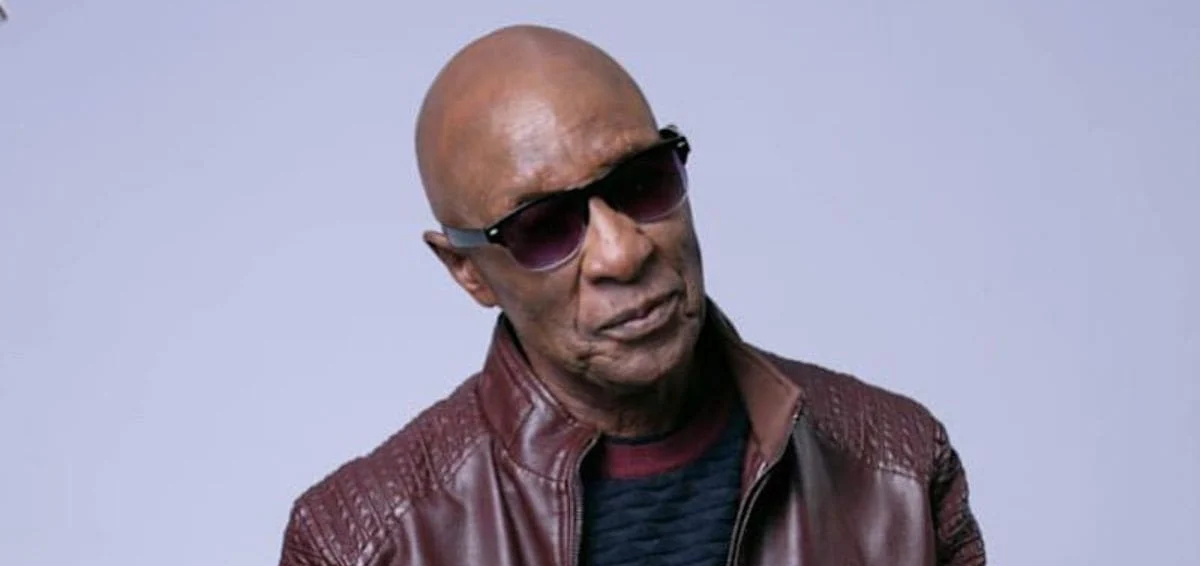
South African music veteran Babsy Mlangeni has died at the age of 83 following a short illness, marking the end of a career that spanned more than five decades.
Mlangeni, who became one of the country’s best-known blind musicians, singer-songwriters and guitarists, died on Thursday, 1 October 2026. The news of his passing was confirmed to Buzz Life News by his son and music executive Lebo Mlangeni. He was 83.
A career spanning more than five decades
Born in Soweto in 1943, Mlangeni attended the Athlone School for the Blind in Cape Town, where he learned to play the guitar.
He went on to build a career as a singer, guitarist and composer, recording music in isiZulu, Sesotho and isiXhosa.
His catalogue included songs such as Bua Nnete, Sala Emma, Botsotso, Lonely Man and Umadlembathini. His music reached audiences across linguistic and cultural boundaries and established him as one of South Africa’s enduring music figures.
His breakthrough came in the late 1960s, with Sala Emma becoming one of his signature songs. In a 2025 interview with 702, Mlangeni reflected on the unexpected success of the song.
“I didn’t know that the song would be special… up until today, I don’t know what made us choose that song [as a single], it just came and I think it’s how God planned it,” he said.
He challenged perceptions of blindness
Mlangeni’s career was also significant because he achieved national recognition at a time when blind and visually impaired people faced widespread social barriers.
Speaking about growing up without his sight, he said his parents encouraged him to believe in his abilities.
“People actually thought blind people are just there to beg, there is nothing else that they can do… there is nothing that you can achieve – but I have proved them wrong,” Mlangeni said.
He added that his ability to write music with a message had played a major role in his journey.
“I was lucky that I had the God-given talent to be able to write quality music, and music with a message to South Africans at large,” he said.
His final years remained connected to music
Even in his later years, Mlangeni continued performing and releasing music.
In 2023, he released Kumnandi, a single produced by kwaito musician Joe Nina, combining elements of amapiano and kwaito in an effort to connect with younger audiences. At the time, Mlangeni said he wanted to remain relevant to a new generation.
He also continued to speak about the importance of artists adapting to changing audiences.
“Every musician has to rebrand to remain relevant to cater to the new generation,” he said in 2023.
A legacy formally recognised
Mlangeni’s contribution to South African music was recognised with a South African Music Awards Lifetime Achievement Award in 2017.
In 2025, he received another national honour when he was recognised at the National Arts and Culture Awards. The Department of Sport, Arts and Culture listed him among the recipients of a Ministerial Artist Living With Disability Award.
The department had also previously identified Mlangeni among South Africa’s living legends whose contribution to the creative sector deserved recognition and preservation.
His influence extended beyond his own recordings. He also mentored fellow visually impaired musician Steve Kekana, who became a celebrated artist in his own right.
A remarkable musical journey comes to an end
Mlangeni’s death comes after more than 50 years in an industry he entered during a difficult period in South Africa’s history.
His music, particularly songs such as Sala Emma, became part of the country’s popular musical heritage, while his career challenged assumptions about what blind musicians could achieve.
In 2023, he reflected on his determination to continue performing, saying: “I am still strong and fit. There is nothing that will slow me down but death and even then when it finally creeps in it will find me on the stage doing what I love.”
An official statement from his family will be released and further details about his funeral and memorial arrangements had not been announced in the latest reports at the time of publication.
