

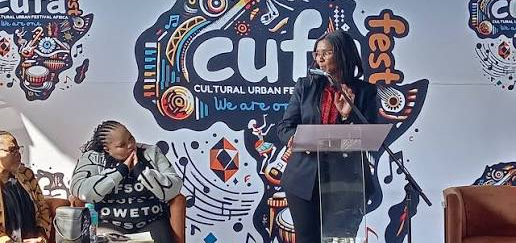
The Mangaung African Cultural Festival (MACUFE) is once again facing questions over its management, procurement and leadership – this time after the Free State government removed a senior supply chain official just days before the province’s flagship cultural festival gets under way.
Takalani Ramabulana, who was the Director of Supply Chain Management in the Free State Department of Sport, Arts, Culture and Recreation, was removed from the position on August 21 and moved to the department’s Archives portfolio.
The move has raised concerns about the timing of the decision, particularly because supply chain management plays a central role in the awarding and administration of contracts for a festival involving millions of rands in public money.
The department has not publicly explained whether Ramabulana was suspended, transferred, redeployed or relieved of his responsibilities, nor has it explained whether his removal is linked to any investigation or alleged misconduct.
The festival is scheduled to start on Thursday.
A festival that was once a provincial success story
MACUFE was launched in 1997 by the Free State provincial government as an African arts and culture festival designed to showcase local and international talent.
It quickly grew from an event attracting about 30 000 people in its first year into one of the country’s biggest cultural festivals, with reported attendance reaching about 140 000 at its peak.
The festival was created partly to provide a platform for African culture and artists at a time when many established South African arts festivals were seen as being dominated by Western and Eurocentric programming.
Its objectives include developing Free State artists, creating opportunities for local performers, promoting tourism and using arts and culture to stimulate the provincial economy.
A 2015 University of the Free State study cited by the festival estimated that MACUFE generated about R92-million in visitor expenditure in Bloemfontein, while total spending by festivalgoers, including locals, was estimated at R150-million.
That economic importance makes the recurring administrative problems around the festival particularly significant.
The trouble did not start with Ramabulana
The latest crisis is part of a much longer history of disputes around MACUFE’s procurement and administration.
One of the biggest flashpoints came in 2022, when the Free State government awarded a multimillion-rand contract to C-Squared Consumer Connectedness to manage the festival.
The award was challenged in court by the DS Consortium, which argued that the procurement process had deviated from the tender specifications.
The Free State High Court ultimately found that the award was unlawful and set aside the agreement.
The court found that the department’s decision to award the tender was not fair, equitable and competitive.
The controversy did not end there. The department and C-Squared attempted to challenge the judgment, but the appeal bid was unsuccessful.
The dispute subsequently became one of the major factors hanging over the festival’s future.
Then MACUFE disappeared for two years
After the 2022 controversy, MACUFE was not held in 2023 or 2024.
The festival had already been forced to take a break in 2020 and 2021 because of the Covid-19 pandemic.
But unlike those cancellations, the reasons for the 2023 and 2024 cancellations were never as clear-cut, with questions around procurement and the management of the festival becoming increasingly prominent.
In 2024, MACUFE was facing its second consecutive cancellation despite the provincial government having invited service providers to submit quotations.
That two-year hiatus damaged the continuity of an event that had become an important fixture on the Free State’s cultural and tourism calendar.
The R18-million comeback
In 2025, the provincial government attempted to revive MACUFE with an R18-million allocation.
Then-Free State Premier Maqueen Letsoha-Mathae announced that the province would not issue a traditional tender for the overall management of the festival. Instead, the provincial Department of Sport, Arts, Culture and Recreation would manage the event itself.
The decision came after the procurement battles that had surrounded the 2022 edition.
Letsoha-Mathae argued that the government’s responsibility was not simply to stage an event but to ensure that local artists and businesses benefited from it.
But even the comeback was not without controversy.
In August 2025, MEC Ntombizanele Sifuba withdrew delegated powers from the department’s then-HOD, Steve Tshabalala, during preparations for MACUFE.
Sifuba cited Tshabalala’s conduct in the preparation of the festival.
That intervention immediately raised questions about the stability of the department’s leadership at a crucial stage of preparations.
Now the supply chain crisis
A year later, the spotlight has shifted to Ramabulana.
Insiders have questioned why he was removed from the supply chain position so close to the festival and whether the decision could affect procurement processes linked to MACUFE.
One source described the circumstances surrounding the removal as “very suspicious”, pointing to other controversies surrounding this year’s festival.
Among those issues was a dispute over the proposed booking of singer Thandiswa Mazwai.
Reports indicated that an amount of about R1.3-million had been presented for her appearance, while supply chain officials had reportedly received a quotation of about R960 000 before travel and accommodation.
That discrepancy prompted questions about how the figure had been calculated and how procurement decisions were being handled.
The cancellation of Malian music legend Salif Keita’s scheduled appearance has added another layer of pressure.
Keita withdrew from his scheduled MACUFE performance in August, citing concerns over rising anti-migrant hostility in South Africa.
His withdrawal has created further questions about contractual arrangements and whether the province will be able to recover money already committed to the booking.
‘They should take the blame’
The latest controversy has also exposed renewed tensions over who should ultimately take responsibility for the problems surrounding MACUFE.
A senior departmental source told Sunday World that responsibility should not be placed on one official.
“All the three bosses within the department are responsible for the mess that is happening there. They should take the blame for all wrong things happening over Macufe,” the source said.
The source also compared Ramabulana’s removal with the intervention involving former HOD Tshabalala during the previous MACUFE preparations.
The implication is that the department is repeatedly responding to crises at senior management level instead of addressing the underlying structural problems around the festival.
Those claims, however, remain allegations from unnamed departmental sources and have not been independently confirmed.
Department refuses to open up
The provincial department has declined to provide detailed answers about Ramabulana’s removal.
The department also did not disclose the identity of Ramabulana’s replacement, the official who authorised the move or whether the official had been handling outstanding MACUFE tenders, contracts, invoices and supplier appointments.
Questions about whether the Auditor-General, internal audit or National Treasury had raised concerns about supply chain processes were also not answered.
Ramabulana declined to comment, saying the departmental spokesperson was better placed to respond.
MEC Sifuba also did not respond to the publication’s questions, while HOD Masego Tshabalala and CFO Pule Khiba referred media enquiries to the department’s communications office.
Why the pressure matters
The problem facing MACUFE is bigger than one official being moved.
The festival sits at the intersection of culture, tourism, public procurement and provincial politics. Every procurement dispute therefore has the potential to become a political and financial problem.
The 2022 court battle demonstrated how quickly procurement disagreements can threaten the festival itself. The subsequent cancellation of two editions showed the consequences of administrative uncertainty.
And now, just as MACUFE attempts to establish itself again, the removal of a supply chain director has once again put the department’s procurement processes under scrutiny.
There are also broader concerns about the benefits of the festival reaching Free State businesses.
Recent reports have questioned the awarding of some 2026 service-provider contracts after dozens of companies reportedly submitted bids, with some successful companies coming from outside the province.
That has intensified the debate over whether MACUFE is delivering on one of its central promises – using a major publicly funded cultural event to grow local businesses and create opportunities for Free State artists and service providers.
From cultural flagship to annual crisis
MACUFE remains one of the Free State’s most recognisable cultural brands.
Its history shows that the festival can attract huge audiences, generate economic activity and provide a national platform for African artists.
But its recent history also tells another story – one of cancelled festivals, court battles, disputed tenders, leadership interventions and continuing questions about procurement.
The latest removal of Ramabulana has therefore landed at a particularly sensitive moment.
For the provincial government, the immediate challenge is to ensure that the festival goes ahead smoothly.
The bigger challenge is restoring confidence in how MACUFE is managed, how public money is spent and whether the festival can once again become a cultural success story rather than a recurring governance controversy.
