

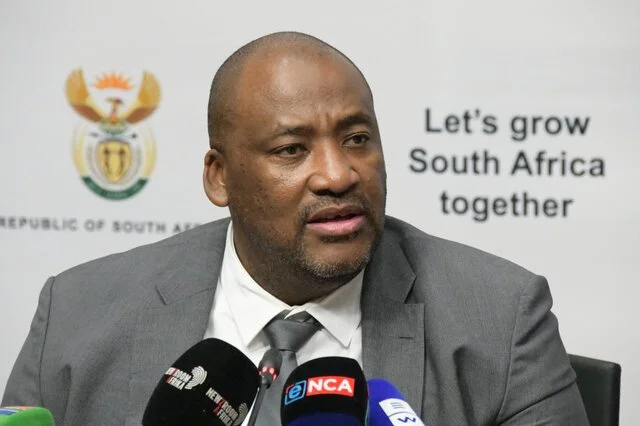
Sports, Arts and Culture Minister Gayton McKenzie has pledged R100,000 to the family of late boxing champion Zolani “Last Born” Tete while promising a major push to revive boxing in the Eastern Cape and improve the financial rewards for fighters.
McKenzie made the commitments on Wednesday at Tete’s memorial service at the historic Orient Theatre in KuGompo City, where the boxing fraternity, political leaders, family members and supporters gathered to remember the two-time world champion.
The minister said Tete would be honoured at the next Legends Awards in Sun City, with the R100,000 award to be handed to his father.
“Last Born will get an award with R100 000, and we will give it to the father. This is our contribution to what he has done,” McKenzie said.
A champion whose life was cut short
Tete, 38, was shot dead outside his home in NU17, Mdantsane, on 21 August.
Police said he was sitting in his vehicle waiting for his residential gate to open when two armed men wearing balaclavas approached and opened fire. A 27-year-old woman travelling with him was also shot and wounded. The motive for the killing remains under investigation.
His death brought a violent end to a remarkable career.
Tete became a two-weight world champion, winning the IBF junior-bantamweight title in 2014 before capturing the WBO bantamweight crown in 2017. He became internationally famous that year when he stopped fellow South African Siboniso Gonya in just 11 seconds, a performance recognised as the fastest knockout in a world-title fight.
McKenzie said Tete’s contribution to South African boxing was difficult to measure.
“I intend very clearly to honour him, presumably at our next sports awards because what he has done has never been done. In Belfast, he broke a record by knocking out his opponent in eleven seconds. The importance of this man can never be put into words,” he said.
He also revealed that he had instructed Boxing South Africa to ensure that the organisation did something for Tete’s family.
“I’ve given the CEO of Boxing SA further instructions on top of what I’m going to do; he must also do something with the family,” McKenzie said.
Tete murder case moves through court
The tributes come as the criminal case surrounding Tete’s death moves through the courts.
Four suspects have been arrested in connection with the killing. The 22-year-old suspect arrested on 22 August faces charges of murder and attempted murder, with the attempted murder charge relating to the woman who was wounded during the attack. Three other suspects were subsequently arrested and brought before court.
On 26 August, four accused appeared in the Mdantsane Magistrate’s Court, with the State opposing bail in a case prosecutors have described as involving a planned killing. The accused include an alleged mastermind, alleged hitmen and an alleged middleman.
The court proceedings remain ongoing, and the allegations against the accused have yet to be tested at trial.
Why the Eastern Cape matters to boxing
McKenzie’s promises come against the backdrop of a boxing culture that has produced generations of champions from East London and Mdantsane.
Mdantsane has long been described as South Africa’s “boxing mecca”. Academic research into the region’s boxing economy says the area has produced more than 20 world champions and over 50 national champions.
The story goes back decades. Nkosana “Happy Boy” Mgxaji helped put Mdantsane boxing on the map after defeating Durban boxer Moses Mthembu at Sisa Dukashe Stadium in 1972. From there, a remarkable conveyor belt of fighters emerged, including Vuyani “The Beast” Bungu, Welcome Ncita, Masibulele “Hawk” Makepula, Noni Tenge and Tete.
The scale of that achievement is remarkable. Research by Professor Njabulo Ndebele found that between 1980 and 2010, Mdantsane had produced 23 world champions and 50 national champions – an extraordinary contribution considering the relatively small size of the township.
But that history has also existed alongside challenges around funding, facilities, promotion and opportunities for young fighters.
McKenzie has previously criticised the financial conditions facing boxers and raised concerns about the state of boxing’s administration and the treatment of fighters. In 2025, he said millions had disappeared from the boxers’ benevolent fund and criticised promoters who paid fighters extremely low purses.
McKenzie wants to put money back into boxing
At Tete’s memorial, the minister said the province’s boxing tradition could not be allowed to fade.
One of his major commitments is the return of the annual Steve Tshwete Boxing Tournament in December, with R10 million allocated towards the event. McKenzie also said about R1 million had already been transferred to the province, with a further R300,000 earmarked for female boxers.
He also committed to improving the earnings of professional boxers, saying no boxer should walk away from a professional bout with an inadequate purse.
The focus, therefore, is not only on producing champions but on creating a boxing system in which fighters can earn a sustainable living from their careers.
The Orient Theatre could get a new life
Another key part of McKenzie’s plans is the revival of the Orient Theatre, a venue deeply connected to the history of boxing in Mdantsane.
The theatre hosted numerous Tete fights during his career. According to local reporting, he fought there 13 times, winning 12 and drawing once, with his first appearance at the venue coming in 2006.
McKenzie said an agreement had been reached with Buffalo City Metro to renovate the historic facility, potentially giving the region another important venue for boxing events and helping restore some of the infrastructure associated with its fighting tradition.
For a province that has repeatedly produced elite fighters, the condition of its boxing infrastructure has become part of the wider debate about whether the next generation can follow in the footsteps of its champions.
Turning Tete’s death into a legacy
McKenzie’s intervention comes at a deeply emotional moment for Eastern Cape boxing.
Tete was not simply remembered as a fighter who won world titles. He remained involved in the community and continued working with younger boxers. Boxing South Africa chief operations officer Mandla Ntlanganiso said Tete continued training and sharing his knowledge with aspiring fighters even during his four-year lay-off.
That makes the minister’s proposed investment significant beyond the memorial itself.
The challenge will now be turning the promises into a lasting programme – one that supports gyms, coaches, amateur fighters, female boxers and professionals while rebuilding the infrastructure that once made the Eastern Cape one of the strongest boxing regions in the country.
For McKenzie, that is part of ensuring Tete’s death does not become the final chapter of the province’s boxing story.
Instead, the minister wants the next generation to inherit the legacy of fighters such as Tete, Bungu and Ncita – and to have the financial and institutional support to take that legacy even further.
