

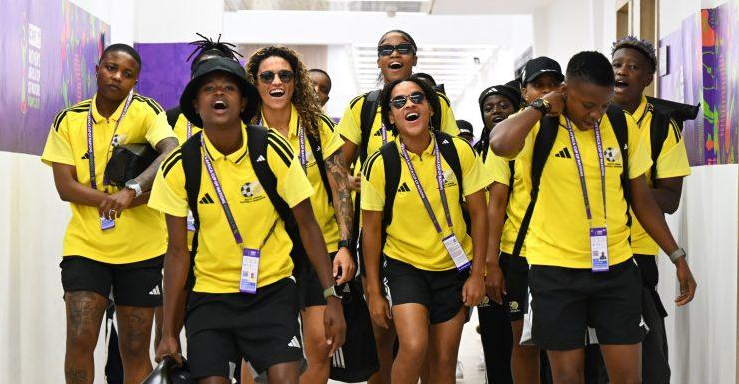
Banyana Banyana have kept their hopes of playing at the 2027 FIFA Women’s World Cup alive after producing a dramatic 2-1 victory over African giants Nigeria in Casablanca, Morocco, on Thursday night.
The victory is significant not only because it moves South Africa into the next stage of the World Cup qualification process, but because Nigeria have long been one of the most difficult opponents Banyana have faced in African women’s football.
South Africa had to beat the Super Falcons after missing out on automatic qualification for the World Cup through the Women’s Africa Cup of Nations. Banyana were eliminated by hosts Morocco in the quarter-finals, while Nigeria were also knocked out at the same stage after losing 1-0 to Cameroon. The two former continental champions were therefore forced into a crucial play-off, with the winner earning a place in FIFA’s inter-confederation play-off tournament.
Banyana delivered when it mattered most.
The match remained goalless at half-time before Thembi Kgatlana broke the deadlock in the 56th minute. Hildah Magaia provided the pass, with Kgatlana keeping her composure to give South Africa the lead.
Captain Refiloe Jane then doubled the advantage in the 76th minute, firing home after the ball fell to her inside the Nigerian penalty area.
The match appeared to be slipping away from Nigeria, but the Super Falcons were handed a late lifeline when a VAR review found that Jane had handled the ball inside the box. She was shown a second yellow card and sent off, while Christy Ucheibe converted the resulting penalty in stoppage time.
Suddenly, South Africa were down to 10 players and Nigeria had an opportunity to force a dramatic finish. Banyana, however, held their nerve to secure a 2-1 victory and eliminate one of the most decorated teams in African football.
The result carries extra weight because of the long-standing rivalry between South Africa and Nigeria. The two nations have repeatedly met at decisive stages of major African tournaments, creating one of the continent’s most compelling rivalries in women’s football.
Nigeria have historically held the upper hand. Before this latest meeting, the Super Falcons had won eight of their 11 previous Women’s Africa Cup of Nations encounters with Banyana, with South Africa winning three. Their rivalry stretches back to the 2000 WAFCON final, when Nigeria defeated hosts South Africa 2-0. Two years later, Nigeria inflicted an even heavier defeat, winning 5-0 in the semi-finals.
Nigeria’s dominance is part of a much bigger football legacy. The Super Falcons are the most successful team in the history of the Women’s Africa Cup of Nations, having won the continental title a record 10 times. Their latest triumph came in 2025, when they came from two goals behind to defeat Morocco 3-2 in the final and reclaim the African crown.
They have also been a remarkably consistent presence on the global stage. Nigeria qualified for every FIFA Women’s World Cup from the inaugural tournament in 1991 through to 2023, making their elimination from the 2027 qualification race particularly significant.
For South Africa, beating Nigeria has therefore become about more than one match. It represents another step in Banyana’s emergence as a genuine continental power.
Banyana won their first Women’s Africa Cup of Nations title in 2022, defeating Morocco 2-1 in the final. They also reached the semi-finals of the 2024 tournament, where Nigeria eventually beat them 2-1 before going on to win the competition.
There is also a wider history of closely fought encounters between the two nations. Nigeria’s football relationship with South Africa has produced memorable matches across both men’s and women’s football, with the Super Falcons traditionally enjoying the advantage in the women’s game. In 2024, Nigeria defeated Banyana 1-0 in an Olympic qualifying match, while South Africa had previously beaten Nigeria 2-1 at the 2022 WAFCON.
That history makes Thursday night’s result even more meaningful.
It was also a reminder of how much the balance of power in African women’s football has shifted. Nigeria remain the continent’s most successful women’s football nation, but South Africa have increasingly challenged their dominance, winning the 2022 WAFCON and reaching the knockout stages of the 2023 FIFA Women’s World Cup.
The victory in Casablanca does not, however, mean Banyana Banyana have already qualified for the 2027 World Cup in Brazil.
Instead, South Africa have earned a place in FIFA’s inter-confederation play-off tournament, where they will have to overcome further opposition from other confederations. The first phase is scheduled for November and December 2026 and will feature six teams, with only two advancing to the final play-off phase. Those teams will then compete for the remaining World Cup places.
For now, though, Banyana can celebrate a victory that will be remembered as another defining chapter in their growing rivalry with Nigeria.
The Super Falcons arrived with one of the strongest records in African women’s football. Banyana left Casablanca with the result that mattered most.
South Africa 2, Nigeria 1.
And the road to Brazil remains open.
