

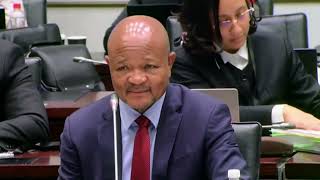
Suspended Police Minister Senzo Mchunu is facing renewed scrutiny at the Madlanga Commission of Inquiry after evidence emerged that he allegedly facilitated the transfer of a confidential Inspector-General of Intelligence (IGI) report to the Investigating Directorate Against Corruption (IDAC), despite established procedures governing access to such information.
The issue came to the fore during the testimony of IDAC prosecutor Drushantha Ramsamy on Tuesday, 11 August 2026. The commission is investigating allegations that criminal networks had infiltrated parts of South Africa’s criminal justice system, following explosive claims made by KwaZulu-Natal Police Commissioner Lieutenant-General Nhlanhla Mkhwanazi in July 2025.
The latest evidence places Mchunu at the centre of questions about how investigations involving senior Crime Intelligence officials were pursued.
In early 2025, Mchunu referred allegations concerning procurement irregularities within Crime Intelligence, as well as the appointment of Brigadier Dineo Mokwele, to the IGI for investigation. The IGI subsequently produced a report, but IDAC had reportedly been warned that it could not access information from an investigation that was still under way.
Ramsamy told the commission that the IGI had made its position clear during a January 2025 meeting involving IDAC officials.
“The IGI Act prescribed procedures for sharing such information, while [IDAC’s] retired advocate Paul Louw had explained that specific channels had to be followed to obtain an IGI report,” Ramsamy testified.
According to Ramsamy, those restrictions did not prevent the report from eventually reaching IDAC.
She said that, in September 2025, IDAC chief investigator Dylan Perumal told her that Mchunu had arranged for a person to fly to the Eastern Cape with a hard copy of the completed IGI report for him.
Ramsamy said she understood that Mchunu had received the report from the IGI, although she could not establish what authority had been used to obtain it. She was, however, clear that the manner in which the report reached IDAC was irregular.
“The report was not supposed to come to us in that way via the minister,” she said.
The evidence is significant because the IGI operates under its own legislative framework and information from its investigations is subject to prescribed procedures. At an earlier meeting, Ramsamy said, an IGI legal representative had even warned Perumal that his approach would not be accepted.
The meeting reportedly became heated, with Ramsamy telling the commission that Perumal became “agitated”. Advocate Jayashree Govender allegedly responded that his “cowboy tactics” would not work with the IGI.
Ramsamy further testified that Perumal wanted Govender arrested after she refused to provide the requested information, prompting her to produce the IGI Act and explain the legal restrictions surrounding the report.
The matter resurfaced months later after the IGI completed its investigation. Ramsamy said the report was eventually transported to the Eastern Cape and provided to Perumal, who then shared it with her on WhatsApp.
The report itself has become an important piece of evidence, although access to it remains restricted. Ramsamy brought hard copies before the Madlanga Commission, but the commission has not been authorised by the National Prosecuting Authority to formally use the document.
Evidence leader Advocate Lee Segeels-Ncube told the inquiry that this was the first time anyone at the commission had seen the report.
The controversy comes against a wider backdrop of allegations concerning IDAC’s investigations into senior Crime Intelligence figures, including former Crime Intelligence boss Dumisani Khumalo and suspended national police commissioner Fannie Masemola.
Charges against Khumalo linked to Mokwele’s appointment have since been provisionally withdrawn, while questions have also been raised about the prosecution of Masemola in connection with businessman Vusimuzi “Cat” Matlala’s controversial Medicare24 contract.
The commission has heard allegations that the investigations targeting Crime Intelligence officials may have gone beyond the original complaint that triggered the IDAC probe.
Mchunu has previously denied becoming involved in factional battles within Crime Intelligence. However, his relationship with IDAC has increasingly come under the commission’s microscope.
Ramsamy previously told the inquiry that former IDAC head Andrea Johnson had meetings with Mchunu, including one in January 2025. Following one of those engagements, Johnson reportedly said the minister “wanted to clean SAPS and Crime Intelligence”.
The evidence also needs to be viewed against Mkhwanazi’s broader allegations about the dismantling of investigative structures. One of his central claims was that Mchunu issued a directive on 31 December 2024 to disband the Political Killings Task Team, which had been established in 2018.
Mkhwanazi has alleged that the move was intended to protect politically connected individuals linked to criminal activity, an allegation that Mchunu has disputed.
The Madlanga Commission was established by President Cyril Ramaphosa to investigate the scope and credibility of allegations that South Africa’s criminal justice system had been compromised. The latest testimony adds another layer to the inquiry’s examination of the relationships between political office-bearers, intelligence structures and corruption investigators.
Ramsamy is expected to continue her evidence before the commission on Friday, 14 August.
