

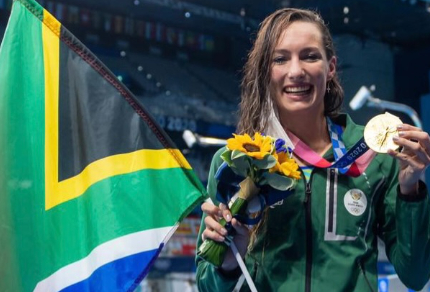
One of South Africa’s most decorated Olympian, Tatjana Smith, has announced that she will represent the Netherlands in international swimming competitions, including the 2028 Los Angeles Olympic Games, raising questions about what the decision means for her South African citizenship, the country’s sporting future and the circumstances behind her departure.
The 29-year-old, who won two gold and two silver medals at the Tokyo 2020 and Paris 2024 Olympic Games, confirmed on Tuesday that she had changed her sporting allegiance after receiving approval from World Aquatics.
However, the move does not mean Smith has given up her South African citizenship or is leaving the country.
Smith already holds dual South African and Dutch citizenship, and will retain her South African nationality while competing under the Dutch flag. She is also expected to remain based in South Africa and continue training with the coaching team that has supported her career.
In her announcement, Smith explained that the decision was about exploring her Dutch heritage, accessing a different high-performance sporting environment and giving herself a more sustainable opportunity to continue swimming.
“For the next chapter my dream looks different. I have always been both Dutch and South African – both countries are a part of who I am – but sport requires you to choose one to represent,” she said.
“At the beginning of my career I chose South Africa, a decision I will always treasure. Now, I’ve made the decision to represent the Netherlands in the next chapter of my swimming career.”
She added that the decision would allow her to explore another part of her identity and heritage through sport.
The switch comes after Smith’s difficult relationship with Swimming South Africa (SSA), particularly over the handling of her prize money following the 2023 World Aquatics Championships in Fukuoka, Japan.
Smith won gold in the 200m breaststroke and silver in the 100m event at the championships. However, the federation withheld her $35,000 prize money for more than a year, citing an alleged kit violation.
The money was eventually paid, but a subsequent dispute over the interest earned while it was being withheld escalated into a legal matter, with Smith demanding payment.
In an interview with Carte Blanche, Smith also spoke about the financial and personal sacrifices behind her swimming career, revealing that her family and support network had invested approximately R10-million over 16 years.
She described her relationship with the federation as having been largely absent, crediting her family, coaches and personal support network for helping her reach the highest level of international swimming.
Her decision to change sporting allegiance therefore comes against a backdrop of concerns about athlete support, funding, governance and the financial burden placed on South African competitors.
“The reality is that this opportunity also offers greater high-performance support and the potential to build a more sustainable career,” she said.
“The financial and practical challenges of swimming were among the reasons my previous career became difficult to sustain. This time I want to make a different choice: protect the love that brought me back to the sport and give myself the best possible opportunity to pursue my new Olympic dream.”
Smith also made it clear that her decision should not be interpreted as a rejection of South Africa.
“I chose South Africa at the beginning of my career because I wanted to prove what was possible, even when the system didn’t make it easy, and I did,” she said.
“But I also believe our athletes deserve a system that gives them the opportunity to thrive, not just survive.”
What does this mean for her South African citizenship?
One of the biggest questions surrounding the announcement is whether Smith has lost her South African citizenship by choosing to represent another country.
The answer is no. Sporting nationality and legal citizenship are two different things.
Smith already holds citizenship in both countries, which allows her to meet the nationality requirement for representing the Netherlands. Changing the country she competes for does not automatically cancel her South African citizenship.
South African citizenship law also protects dual nationality. In May 2025, the Constitutional Court confirmed that the automatic loss of South African citizenship for citizens who acquired another nationality without prior ministerial permission was unconstitutional.
Home Affairs Minister Leon Schreiber welcomed the judgment, saying: “South African law allows for dual citizenship, and there is no justification for South Africans to be deprived of their birthright in the manner that was previously done.”
Smith can therefore continue to hold her South African passport, live in the country and maintain her personal and professional connections here.
She has also indicated that she intends to continue supporting local athletes through the Lighthouse Sport Foundation.
What changes is the country she represents in international competition.
Under the International Olympic Committee’s rules, athletes with more than one nationality may elect which country to represent, subject to eligibility requirements, particularly if they have previously competed for another country at the Olympic Games or recognised international championships.
World Aquatics also has regulations governing changes in sporting nationality, including approval requirements and a waiting period. In Smith’s case, World Aquatics has confirmed the change.
What does South Africa lose?
For South Africa, the departure is significant because Smith is not just another international swimmer. She is the country’s most decorated Olympic athlete, with four Olympic medals.
At Tokyo 2020, competing as Tatjana Schoenmaker, she won gold in the 200m breaststroke in a world-record time and silver in the 100m breaststroke.
At Paris 2024, she won gold in the 100m breaststroke and silver in the 200m event.
Her achievements helped put South African women’s swimming on the international map and inspired a generation of young athletes.
With her switch, future international medals won while representing the Netherlands will be credited to the Dutch team rather than South Africa.
However, her four Olympic medals will remain part of South Africa’s sporting history. The change does not erase her previous achievements or transfer those medals to the Netherlands.
The downside for South Africa is that the country loses the opportunity to have one of its strongest swimmers competing in its colours at future international championships and the 2028 Olympics.
It also raises uncomfortable questions about whether South Africa’s sporting structures are doing enough to retain elite athletes, particularly those who have already demonstrated their ability to win at the highest level.
On the other hand, Smith’s continued presence in South Africa, her decision to maintain her training relationships and her involvement in the Lighthouse Sport Foundation mean she could still contribute to the development of local swimming outside the national team system.
Why is the Netherlands an attractive option?
The Netherlands offers Smith an opportunity to compete in a different high-performance environment, with greater support structures and potentially more sustainable financial and practical arrangements.
Her Dutch heritage also gives her a personal connection to the country beyond swimming.
For Smith, the switch is an opportunity to experience another sporting culture, learn from its systems and continue competing without carrying the same financial pressures she previously described.
She has said she hopes to bring the knowledge gained from the Dutch swimming environment back to South Africa.
“I believe there is so much we can learn from other sporting systems, and sometimes making a difference means stepping outside the system to understand how we can make it better, from a different position,” she said.
Her decision could also reignite conversations about athlete funding in South Africa, where the costs of competing internationally have increasingly become a concern for athletes.
The move comes at a time when Swimming SA is facing further scrutiny over its governance. Its president, Alan Fritz, and chief executive, Shaun Adriaanse, were provisionally suspended by the World Aquatics integrity unit in August 2026 over potential violations of the organisation’s integrity code. The allegations are subject to the relevant processes and are not findings of guilt.
What happens next?
Smith retired following the Paris Olympics in 2024 but announced her return to competitive swimming in September 2026.
She has since set her sights on the 50m breaststroke, which will make its Olympic debut at the 2028 Los Angeles Games, giving her a new competitive target.
Her first international competition representing the Netherlands is expected to be the World Aquatics Swimming Championships in Beijing, China, from 1 to 6 December 2026.
Despite the change, she will remain in South Africa and continue working with the people who helped shape her career.
For South Africans, the announcement is bittersweet. The country will no longer see its most decorated Olympian competing in the green and gold, but her decision also highlights a bigger question about the conditions under which local athletes are expected to build and sustain successful careers.
Smith’s message is that her achievements as a South African will always remain part of her story, even as she begins a new chapter under a different flag.
“Choosing this path doesn’t take away from the first. It doesn’t diminish the medals I’ve won, the pride I’ve felt singing the South African national anthem or everything I’ve achieved together. That will always be part of my story,” she said.
