
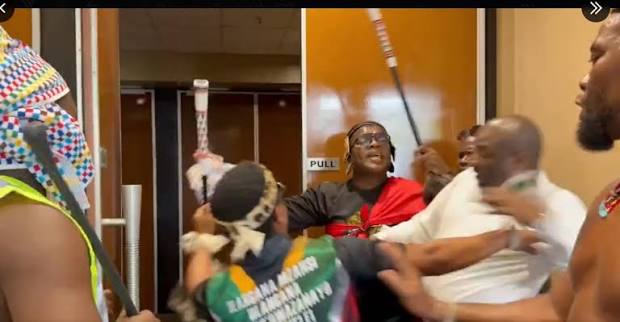
A group of Zulu amabutho who stormed an Ingonyama Trust Board investment meeting at the Durban ICC on Wednesday have apologised for disrupting proceedings, saying they had entered the venue because of concerns raised by Zulu King Misuzulu kaZwelithini about the Trust.
The group, led by Nkosikhona “Phakel’umthakathi” Ndabandaba and joined by Ngizwe Mchunu, forced their way into the venue during the Rural Economy Development and Investment Indaba, bringing proceedings to a halt.
The two-day indaba, which began on 30 September and runs until 1 October, was organised by the Ingonyama Trust as an investment platform connecting traditional leaders, communities, investors, government, development finance institutions and project developers.
The group initially confronted those attending the event before later stopping their protest after realising that amakhosi were among those in the room.
Ndabandaba subsequently apologised to those gathered.
“We’d like to apologise. We were not aware that there were chiefs in this meeting,” he said.
He explained that the group believed it was responding to concerns previously raised by the Zulu monarch.
“We were just following through on the King’s complaint about the Ingonyama Trust,” he said.
‘We used the wrong entrance’
Ndabandaba said the group had been under the impression that the King had objected to the meeting and that they were acting in response to his previous comments.
“He complained again during uMkhosi Womhlanga, and even yesterday during uMkhosi weLembe he complained and mentioned that the meeting would be held here at the ICC,” he said.
He also acknowledged that the group had entered the venue in the wrong manner.
“We are apologising because we used the wrong entrance and came in through the back door,” Ndabandaba said.
He stressed that their objection was directed at the Ingonyama Trust Board and not traditional leaders attending the event.
“The King has never complained about amakhosi, but about the Ingonyama Trust Board,” he said.
“We were also shocked when amakhosi called us and reprimanded us. We love and respect amakhosi, and this was really a mistake. We humbly apologise.”
Trust says no action will be taken
Ingonyama Trust acting chief financial officer Sanele Mkhize confirmed that the disruption had occurred but said the Trust would not take action against the group following their apology.
“Firstly, we are not sure if these are really amabutho. Nonetheless, the Trust will not take action against them because they apologised,” Mkhize said.
Mkhize also disputed the suggestion that the gathering had been organised without the knowledge of King Misuzulu.
“This was not a meeting for amakhosi but an investment conference. There’s a difference,” he said.
“The King was informed about this meeting and he was invited.”
The Trust said the conference continued after the apology and was expected to proceed on Thursday.
Why the meeting became controversial
The confrontation comes against the backdrop of an increasingly complicated dispute involving the Zulu monarch, the Ingonyama Trust Board and the management of land held by the Trust.
The Ingonyama Trust administers approximately 2.8 million hectares of land across KwaZulu-Natal. Government says the land is held in trust for communities, with the Trust Board responsible for its administration.
The Trust’s own information places the landholding at about 2.8 million hectares and says it serves millions of beneficiaries across traditional authorities in KwaZulu-Natal.
The issue of who has authority over the Trust and how decisions affecting its land and investments should be made has been the subject of continuing tension.
King Misuzulu is the sole trustee of the Ingonyama Trust, while the Ingonyama Trust Board administers its affairs under the KwaZulu-Natal Ingonyama Trust Act.
The investment conference
The Trust’s Rural Economy Development and Investment Indaba was designed as a platform to discuss investment opportunities involving rural communities.
According to the Trust, the programme focuses on areas including agriculture, tourism, mining, climate-smart solutions and digital connectivity, with the stated aim of moving projects from concepts towards bankable investments.
The Trust says the event brings together traditional leaders, investors, government representatives, development finance institutions and project developers.
It was this investment focus that appears to have contributed to the concerns expressed by the amabutho, who said they feared business interests could affect land traditionally associated with communities and amakhosi.
Ndabandaba said the group was concerned about what he described as wealthy businesspeople seeking to use investment opportunities involving traditional land.
“We have these super rich people who have a mission to take the land from, the only land in KZN, the little land which belongs to Amakhosi they want to take it in the name of investments,” he said, according to a report by eNCA.
Those claims are allegations and were not established by the disruption itself.
Long-running governance dispute
The confrontation also comes after months of institutional and political tension around the Trust.
In March 2026, Land Reform and Rural Development Minister Mzwanele Nyhontso announced the dissolution of the Ingonyama Trust Board, citing governance circumstances that he said had become unsustainable following the resignation of several board members. Government said the board had been left with four serving members, while regulations required five members for a quorum at a board meeting.
The decision was subsequently challenged in court. In March, the Pietermaritzburg High Court overturned the minister’s decision, ruling that the dissolution was unlawful and outside his powers. The ruling meant the board remained in office.
The dispute has included questions around the Trust’s finances, investment structures and accountability.
Parliament’s Portfolio Committee on Land Reform and Rural Development has previously raised concerns about Ingonyama Holdings, the Trust’s investment and commercial vehicle. In 2025, the committee heard that the Trust had provided Ingonyama Holdings with R41 million in seed funding and that the money had not been returned or fully accounted for. The committee also heard about complaints involving the company’s directors and governance.
These matters form part of the broader context in which the latest confrontation took place.
Conference continues after apology
Despite the dramatic interruption, the Ingonyama Trust said the investment indaba would continue.
