

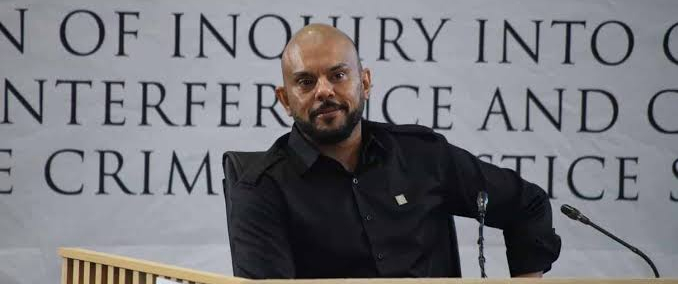
The Madlanga Commission of Inquiry has confirmed that criminal charges have been laid against North West businessman Suliman Carrim after he repeatedly failed to comply with an order requiring him to appear and testify before the inquiry.
Commission spokesperson Jeremy Michaels confirmed on Monday that the charges were laid last week, following an instruction from commission chairperson retired Justice Mbuyiseli Madlanga.
The development marks a significant escalation in the commission’s long-running efforts to secure Carrim’s further testimony.
Charges laid after repeated non-compliance
Michaels said the commission’s secretary, Dr Nolitha Vukuza, had formally laid the criminal charges on behalf of the inquiry.
“Justice Madlanga had instructed the secretary of the commission to lay criminal charges against Mr Suleyman Karim. And indeed, that has been done,” Michaels said.
“The criminal charges have been laid against Mr Karim by the commission, by the secretary, on behalf of the commission. And that matter is now in the hands of the commission’s recommendations task team, the CRTT.”
The charges follow a series of disputes over Carrim’s failure to return to the witness stand after previously giving evidence before the commission.
The official commission record shows that on 14 August, Carrim did not appear despite an earlier ruling ordering him to attend in person. The commission had also given him an alternative – to undergo an independent medical examination by an agreed specialist and provide the resulting report to the commission.
He did neither.
A prolonged dispute over Carrim’s health
Carrim’s appearances before the commission have been repeatedly disrupted by claims of ill health.
His testimony was postponed in April after he was reportedly hospitalised following an alleged heart attack. By May, there was still uncertainty over when he would return to the commission.
The commission subsequently became increasingly dissatisfied with the repeated postponements.
In June, Carrim was effectively given a final opportunity to complete his testimony, with the commission indicating that failure to appear or undergo an independent medical assessment could result in prosecution.
On 29 July, Justice Madlanga dismissed Carrim’s application to indefinitely delay his testimony on medical grounds and ordered him to appear in person. The ruling also provided for an independent medical assessment as an alternative.
When Carrim did not comply, the commission moved towards criminal proceedings.
At the 14 August hearing, Madlanga said the commission could not allow witnesses to decide for themselves whether they would comply with subpoenas and orders.
“This is something that the commission has to do otherwise witnesses will choose to come or not to come testify before it willingly; we cannot, and we will not, have that,” Madlanga said.
Why Carrim’s evidence matters
Carrim is not an incidental figure in the commission’s investigation.
He previously gave evidence concerning his business and financial dealings with individuals whose activities have come under scrutiny during the inquiry, including controversial businessman Vusimuzi “Cat” Matlala.
Carrim told the commission that he had lent Matlala money and denied knowledge of, or involvement in, alleged corruption surrounding a controversial South African Police Service tender.
Matlala himself has emerged as a central figure in the commission’s investigation into allegations surrounding policing, political influence, business interests and corruption.
The commission’s official record also notes a significant discrepancy between the amounts Carrim and Matlala gave in relation to one loan. Carrim testified that the loan was R10 million, while Matlala later told the commission that the amount was R15 million.
Carrim has also been linked through evidence before the commission to other businessmen and transactions that have attracted scrutiny. Importantly, evidence heard by the commission constitutes testimony and allegations being investigated and does not, by itself, amount to a criminal finding against Carrim.
Commission says the law must be enforced
The decision to lay charges is also about the authority of the commission itself.
Michaels previously explained that Carrim had been ordered to appear in person unless he complied with the alternative medical-assessment arrangement.
“Given that Mr Carrim did not comply with the ruling, Justice Madlanga on Friday instructed the secretary of the commission, Dr Nolitha Vukuza, to lay criminal charges against Mr Carrim,” Michaels said.
He said the matter would be referred to the appropriate authorities for investigation and possible prosecution in relation to alleged contraventions of the Commissions Act and the regulations governing the inquiry.
“The Commissions Act, as well as the regulations of this commission, make it an offence to wilfully hinder or obstruct the work of the commission,” Michaels said.
“Persons found guilty of such conduct face penalties including a fine and/or imprisonment.”
The laying of charges is therefore separate from the substantive allegations being investigated by the commission. Carrim has not been convicted of an offence arising from the new criminal case.
What happens next
The criminal matter has now been handed to the commission’s recommendations task team, with Michaels confirming that the process has moved beyond the commission’s internal decision to lay the charges.
The development comes as the Madlanga Commission enters a crucial phase of its work.
The commission, established by President Cyril Ramaphosa to investigate allegations concerning criminality, political interference and corruption within the criminal justice system, has already heard evidence implicating senior political, police and business figures.
Its work has been extended, with the evidence deadline set for 2 October 2026 and the final report due on 16 November 2026.
For Carrim, the criminal case now creates a separate legal process from his involvement as a witness before the inquiry.
For the commission, however, the message is broader: being summoned to give evidence is not voluntary, and repeated failure to comply with an order can have consequences.
The charges also underline the increasingly combative nature of the final stages of the inquiry, as the commission attempts to complete its work while dealing with witnesses who have challenged, delayed or failed to comply with its orders.
