

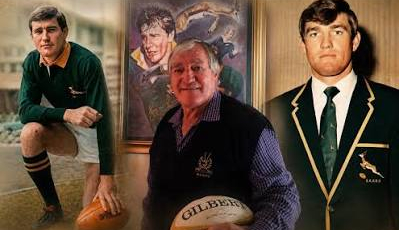
South African rugby is mourning the death of former Springbok centre Joggie Jansen, who passed away at the age of 78 on Sunday morning, just hours after watching the Springboks defeat New Zealand at Cape Town Stadium.
Jansen, remembered as one of the most uncompromising defenders of his generation, reportedly suffered a heart attack while attending a church service in Otjiwarongo, Namibia, where he was visiting. He died on 30 August 2026.
His death came shortly after the Springboks produced another memorable victory over their old rivals, beating the All Blacks 33-26 in Cape Town on Saturday night. Reports say Jansen had watched the match before attending church the following morning.
A sudden loss in Namibia
Jansen was in Namibia when he died. Reports from local media say he collapsed during a church service in Otjiwarongo after suffering what was suspected to be a heart attack.
The circumstances have added a poignant dimension to his death, given his deep connection with the Springboks and the All Blacks. His own international career was launched against New Zealand in 1970, in a match that would ultimately produce one of the most famous tackles in Springbok history.
There has been no detailed public statement from Jansen’s family about his final moments. Tributes from the rugby community have instead been led by SA Rugby and the Griquas rugby fraternity.
The Griqua Rugby Union said: “Today we remember not only a Springbok legend, but also a son of the Northern Cape and a player who was part of the proud rugby history of the Griquas.”
The union added its condolences to “his family, friends and everyone who knew and loved him”, before saying: “Rest in peace, Joggie. Your legacy will live on.”
The tackle that made him a legend
Jansen was born Joachim Scholtz Jansen in Griekwastad, Northern Cape, on 5 February 1948.
He attended Hoërskool Griekwastad with his brother Eben, who would also go on to represent the Springboks. The brothers remain the only Springboks produced by the Northern Cape school.
Jansen’s rugby journey began early. At just 16, he represented the Griquas at the inaugural Craven Week tournament in 1964 before continuing his development at the University of the Free State.
He eventually established himself as a powerful inside centre for Free State, becoming part of a formidable provincial side that won the Currie Cup in 1976.
But it was his Springbok debut against New Zealand at Loftus Versfeld on 25 July 1970 that would secure his place in rugby folklore.
Facing the celebrated All Blacks, Jansen produced a perfectly timed, thunderous tackle on Wayne Cottrell that stopped a dangerous attack and helped shift the momentum of the match.
South Africa went on to win 17-6.
The tackle became one of the defining defensive moments of the era and would remain closely associated with Jansen throughout his life.
A 10-Test Springbok career
Jansen earned 10 Test caps for South Africa between 1970 and 1972, scoring one try.
He played all four Tests against New Zealand during the memorable 1970 series. Although South Africa lost the second Test 9-8 at Newlands, the Springboks recovered to win the third Test 14-3 in Port Elizabeth and the fourth 20-17 at Ellis Park.
Jansen scored his only Test try in that second match against the All Blacks.
He was also part of the Springbok side that toured Australia in 1971, starting all three Tests against the Wallabies as South Africa completed a series clean sweep.
The Springboks won 19-11 in Sydney, 14-6 in Brisbane and 18-6 in Sydney.
Jansen also played in the two-Test series against France in 1971, with South Africa winning the first match 22-9 and drawing the second 8-8.
His final Test came against England at Ellis Park on 3 June 1972.
In addition to his 10 Tests, Jansen represented South Africa in five further tour matches, scoring five tries.
‘A proud Springbok’
SA Rugby president Mark Alexander led the tributes, describing Jansen as an important part of South Africa’s rugby heritage.
“Joggie Jansen was a proud Springbok who represented his country with the commitment and courage required to wear the green and gold jersey at Test level,” Alexander said.
“He was a formidable rugby player and a wonderful example of the uncompromising spirit that characterised the Springboks of his generation.”
Alexander acknowledged that Jansen’s famous tackle against New Zealand had become part of Springbok folklore, but stressed that his contribution went beyond one unforgettable moment.
“His famous tackle against New Zealand is part of Springbok folklore, but his contribution went far beyond one moment. He was a Test player for South Africa and therefore an important part of our rugby heritage,” he said.
A legacy beyond the statistics
Although Jansen’s international career consisted of only 10 Tests, his reputation endured for decades.
He represented an era of Springbok rugby defined by physicality, toughness and uncompromising defence. His ability to make a decisive tackle at a crucial moment became the defining feature of his rugby legacy.
Alexander said Jansen’s contribution should not be measured simply by his number of international appearances.
“He leaves behind a legacy that stretches beyond his 10 Test appearances: that of a player who wore the green and gold in an extraordinary era and whose commitment, toughness and famous defensive skills have ensured that his name remains part of Springbok rugby folklore,” he said.
He extended condolences to Jansen’s family, friends and former teammates.
“We extend our deepest condolences to his family, friends, former team-mates and all those who knew and loved him,” Alexander said.
“May they find comfort in the memories of a remarkable rugby man and in the knowledge that his contribution to the Springbok story will not be forgotten.”
From a teenage Craven Week player in the Northern Cape to Springbok number 444, Currie Cup winner and the man behind one of rugby’s most iconic tackles, Joggie Jansen leaves behind a legacy that stretches far beyond his 10 Tests.
His final hours came after watching another generation of Springboks defeat the All Blacks – the same opponents against whom he made his name more than five decades ago.
