

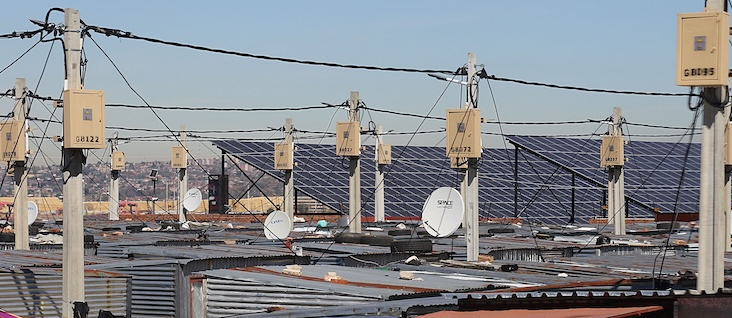
Johannesburg is turning to solar power and battery storage to tackle one of its most persistent service-delivery challenges – providing safe, legal and reliable electricity to informal settlements where conventional grid connections are difficult or, in some cases, not technically feasible.
City Power, the City of Johannesburg’s electricity utility, is investing a combined R517.8 million in solar-powered microgrids across five informal settlements.
Five settlements set to benefit
The alternative electrification programme covers Amarasta and Vukani in Alexandra, Shalazile in Denver, The View in Booysens and Vlakfontein in southern Johannesburg.
The projects are at different stages. Amarasta and Shalazile are already complete and operational, Vlakfontein and Vukani are under construction, while The View is partially complete.
The systems combine solar photovoltaic panels with battery storage, allowing electricity to be generated and stored locally rather than relying entirely on the conventional electricity grid.
The approach is particularly important in settlements where extending the existing grid can be complicated by limited bulk infrastructure, land availability, safety concerns and other technical constraints.
City Power has stressed that the microgrids are not intended to replace conventional electricity infrastructure across Johannesburg, but rather provide an alternative in locations where traditional electrification is difficult.
A response to illegal connections
The investment also comes against the backdrop of Johannesburg’s long-running struggle with illegal electricity connections, electricity theft, meter tampering and unmetered consumption.
Isaac Mangena, City Power’s general manager for public relations and communication, said Johannesburg has more than 300 informal settlements and estimated the utility’s non-technical electricity losses at about R4.5 billion.
“Providing households with legal electricity connections and meters could help reduce illegal connections and improve safety, reliability and revenue collection,” Mangena said.
The idea is that residents can receive formal electricity connections and meters instead of relying on dangerous illegal connections, while City Power can improve revenue collection and monitor electricity consumption.
Residents connected to the microgrids still pay electricity tariffs. Qualifying vulnerable and indigent households can receive assistance through the City’s Expanded Social Package, while qualifying households can also access Free Basic Electricity.
Amarasta was the starting point
The Amarasta project in Alexandra was the starting point for Johannesburg’s microgrid programme.
The pilot was installed during the 2023/24 financial year after conventional grid electrification was found not to be immediately feasible. Lessons from the project were then used to inform subsequent microgrid developments.
The programme initially had much wider ambitions. The city planned to roll out alternative electrification to 21 informal settlements during the 2024/25 and 2025/26 financial years.
However, future expansion will depend on available funding, procurement processes and the timelines of the Human Settlements Department.
The Gauteng government had initially supported the electrification programme through its Energy Emergency Response Plan, before the City of Johannesburg’s Human Settlements Department became involved in identifying and prioritising settlements.
“City Power provided technical support, planning and implementation, while Human Settlements drove the timelines,” Mangena said.
Shalazile offers a glimpse of what is possible
Shalazile in Denver has a particularly significant history.
The settlement was established following the 2023 Usindiso Building fire in Johannesburg, which killed 77 people and displaced hundreds of residents. Some of those displaced residents were subsequently relocated to Shalazile.
Residents there have reported that the microgrid has provided a more dependable source of electricity.
Resident Zakhele Khanyile said the community now has reliable electricity that allows households to light their homes, cook, use refrigerators and iron school clothes.
He also said residents previously faced the additional cost of alternatives such as paraffin and candles, while electricity from the microgrid is accessed through City Power meter boxes.
The results are not identical everywhere
The early performance data shows that the systems can work differently depending on the settlement.
At Amarasta, the microgrid generated 68,725.8kWh in 2024 and 133,107.2kWh in 2025. However, its reported availability fell from 88.61% in 2024 to 50.96% in 2025.
City Power attributed many of the outages at Amarasta to illegal electricity connections.
At Shalazile, meanwhile, system availability was reported at 100% in both 2024 and 2025, with no outages. Electricity supplied there increased from 41,100kWh in 2024 to 500,086.5kWh in 2025.
Questions remain over the final cost
While the approved combined budget for the five projects is R517.8 million, City Power has said the figure should not be treated as the final amount spent.
Three of the projects are incomplete and their final financial obligations have not yet been settled. As a result, the final cost per household cannot yet be calculated.
The South African Photovoltaic Industry Association has also pointed out that the cost of municipal microgrids can include a wide range of components, from solar generation and battery storage to household connections, smart meters, street lighting, security and civil works.
The systems are expected to have lifespans of roughly 20 to 30 years. City Power will therefore have to account not only for the initial R517.8 million investment, but also for ongoing maintenance, specialist skills, spare parts and eventual replacement of major components.
Vandalism, theft and illegal connections remain additional challenges.
For Johannesburg, the microgrid programme represents an attempt to address two problems at once – expanding access to formal electricity in settlements where conventional connections are difficult, while reducing reliance on unsafe and illegal electricity networks.
