

The battle over the planned auction of Nelson Mandela’s personal belongings has reached its final legal frontier, with the Constitutional Court being asked to decide whether 29 items linked to the former president can legally be sold to international buyers.
The case pits Mandela’s eldest daughter, Dr Makaziwe Mandela, and former Robben Island prison warder Christo Brand against the South African Heritage Resources Agency (SAHRA), the Robben Island Museum and the Department of Sport, Arts and Culture.
At stake is not only the proposed New York auction, but a bigger question over who has the right to determine whether objects associated with one of South Africa’s most important historical figures are private possessions or part of the country’s protected cultural heritage.
What is being auctioned?
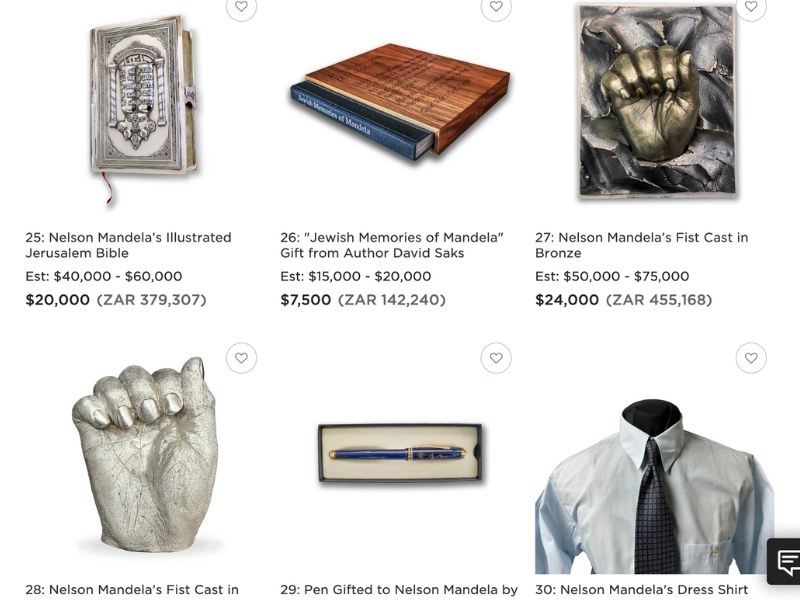
The collection includes some of Mandela’s iconic Madiba shirts, handwritten letters, his hearing aid, three briefcases, four walking sticks, a pair of shoes, sunglasses, a tea set, a tennis racket used on Robben Island and the green barcoded identity document he used when voting in South Africa’s first democratic elections in 1994.
It also includes gifts Mandela received from governments and other institutions.
The disputed collection is being prepared for sale through New York-based Guernsey’s auction house. The auction was initially planned for 2022 but was stopped after SAHRA launched legal proceedings.
Makaziwe has argued that the sale is legitimate and that proceeds would help fund a memorial garden near her father’s grave in Qunu in the Eastern Cape. The proposed memorial project has been cited as one of the reasons behind the auction.
The R21 million Robben Island key
One of the most controversial objects is a broken, handmade key in the possession of Brand.
The key has been associated with Robben Island and was marketed in connection with Mandela, with an estimated auction value of about £1 million – roughly R21 million.
But Brand’s lawyer, Advocate Russell MacWilliam, told the Constitutional Court that it was not an official prison key and was never used to open Mandela’s cell.
He said Brand had been told by another warder that the key was possibly handmade or forged by an inmate and had likely been confiscated.
The issue became particularly contentious when the court questioned how the key had been marketed.
MacWilliam conceded that there had been misrepresentation in the marketing material, telling the court: “There is a case of misrepresentation, there is no doubt about that. It is clear as daylight.”
However, he maintained that Brand should not be held responsible for the way the key was promoted.
Acting Justice Tembeka Ngcukaitobi was sceptical of that argument.
He pointed to contracts Brand had signed allowing the key to appear in Mandela-related exhibitions and questioned the suggestion that the object had nothing to do with Mandela.
Ngcukaitobi said Brand’s version appeared “utterly farfetched”, arguing that the key’s connection to Mandela was central to its commercial appeal.
SAHRA says experts should decide
SAHRA’s legal team, led by Advocate Robin Pearse, argued that the High Court in Pretoria had taken the wrong approach when it found that the items could not simply be treated as heritage objects.
Pearse argued that the question of whether an object has heritage significance should be determined through the appropriate heritage processes and by experts, rather than prematurely by the courts.
SAHRA wants the court to stop the sale and prevent the objects from being transferred to foreign buyers while their heritage status is properly assessed.
The agency relies on the National Heritage Resources Act of 1999 and related heritage declarations, arguing that objects connected to significant political figures and events can fall within South Africa’s protected national estate.
Mandela’s daughter fights back
Makaziwe’s legal team has rejected the suggestion that the belongings automatically qualify as protected heritage simply because they belonged to Mandela.
Advocate Richard Buchanan argued that the objects have no significant heritage value and that an expert had confirmed this position.
He also argued that Makaziwe did not unlawfully export the items because they did not fall within the legal definition of heritage objects.
The argument goes to the heart of the dispute – whether every personal object belonging to a globally significant historical figure should automatically become a protected heritage object.
The Supreme Court of Appeal previously rejected SAHRA’s attempt to impose such a broad interpretation.
SCA dealt SAHRA a major blow
In January 2026, the Supreme Court of Appeal dismissed SAHRA’s appeal with costs.
The SCA found that SAHRA had failed to provide admissible evidence showing that each of the disputed objects met the statutory requirements for cultural significance or special value.
The court also rejected SAHRA’s interpretation that virtually anything connected to Mandela could automatically qualify as a heritage object requiring permission before export.
It warned that laws affecting property rights and potential criminal liability must be clear and constitutionally compliant, rather than so broad that they become uncertain or absurd.
The SCA ultimately concluded that SAHRA had failed to establish that any of the listed objects were heritage objects under the relevant legislation.
Moseneke’s intervention was rejected
The case also attracted the intervention of retired Deputy Chief Justice Dikgang Moseneke, one of the surviving executors of Mandela’s estate.
Moseneke sought permission to participate as a friend of the court, arguing that the dispute had implications far beyond the individual objects.
He argued that the case raised important questions about South Africa’s cultural and political memory and the preservation of Mandela’s legacy for future generations.
The Constitutional Court declined his application, finding that he had not established a case for admission as an amicus curiae.
Moseneke had also raised concerns about the handling of Mandela’s movable assets and referred to the former president’s will, saying that his personal effects were bequeathed to his widow, Graça Machel.
The Constitutional Court has the final say
The Constitutional Court heard arguments in Johannesburg this week, with the proceedings placing the future of the 29 objects firmly before the country’s highest court.
The court questioned both sides about the scope of South Africa’s heritage laws, including concerns that an overly broad interpretation could potentially mean almost anything Mandela touched could be classified as heritage.
At the same time, SAHRA argued that it should be allowed to assess the objects properly rather than having their heritage status effectively decided through the existing litigation.
As of September 9, 2026, judgment has been reserved.
That means the auction has not received the final green light from the Constitutional Court, and SAHRA’s last-ditch attempt to stop the sale remains unresolved.
A fight over more than Mandela’s belongings
Mandela died in December 2013 at the age of 95, but his estate has still not been fully wound up.
The dispute has consequently become a wider argument about the legacy of a man whose personal life, imprisonment and political career are inseparable from South Africa’s history.
For Makaziwe, the objects are personal property that can be sold to fund a memorial project honouring her father.
For SAHRA and its allies, some of those same objects represent pieces of the country’s collective memory that should not simply leave South Africa for the highest international bidder.
The Constitutional Court’s eventual ruling could therefore have consequences well beyond the 29 Mandela objects. It could help define how South Africa balances private property rights against the preservation of its cultural and political heritage.
