

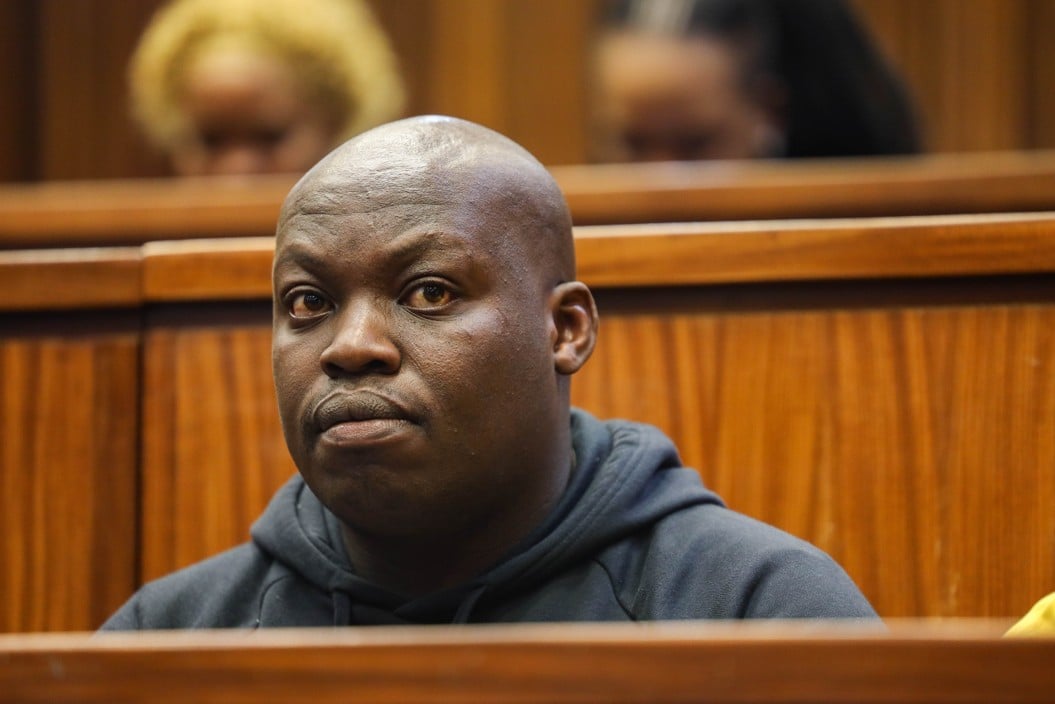
Alleged hitman Musa Kekana has challenged key parts of the State’s evidence about the circumstances of his arrest, accusing a State witness of lying about seeing him driving a Hyundai i20 on the morning he was arrested.
Kekana made the claims in the Johannesburg High Court on Tuesday, 15 September 2026, while continuing his evidence in the trial-within-a-trial in the case involving alleged underworld figure Vusimuzi “Cat” Matlala and four co-accused.
The proceedings are focused on whether evidence obtained during and after Kekana’s arrest on 17 April 2024 was lawfully obtained and can be admitted in the main trial.
Hospital records put alleged suffocation before court
One of the most significant parts of Kekana’s testimony concerned medical records from the day of his arrest.
The court heard that a note by Dr Du Toit recorded that Kekana had allegedly been “suffocated with plastic bag overhead” before he started coughing up blood.
Kekana told the court that he had informed the doctor that the coughing had started on the day of his arrest.
“I informed the doctor that the coughing started today,” he testified.
The records also indicate that Kekana told medical staff he had been suffocated with a plastic bag. His defence has relied on the medical documentation to support his claim that he was assaulted and suffocated while in police custody.
The State, however, has disputed Kekana’s account of what happened during his arrest. Police officers he has implicated have denied assaulting him. The allegations remain subject to cross-examination and a judicial determination.
Conflicting accounts over Kekana’s cough
The medical evidence has also revealed inconsistencies about when Kekana’s coughing began.
The note by Dr Du Toit records one day of coughing, while another record by Dr Mazibuko refers to a two-week history of coughing. A paramedic’s report also referred to a hospital admission approximately two weeks earlier.
Kekana rejected the suggestion that he had been coughing before his arrest.
“No, I was not coughing, I was well,” he told the court when asked whether he had been coughing at the time police arrived or during the two weeks before his arrest.
He maintained that the medical practitioner had been mistaken about the duration of the cough.
“She’s mistaken. Maybe she saw that from the files,” Kekana said.
The court also heard that Kekana had previously been admitted to hospital on 3 March 2024 for approximately a week after what he described as poisoning. The records indicate that he had been intubated during that admission.
Kekana confirmed that he had told the doctor about that previous hospitalisation, but disputed other details recorded in the medical documentation.
Kekana describes what happened after the alleged assault
Kekana testified that a private security company paramedic was waiting outside his home after the alleged suffocation.
According to his evidence, he was instead taken to 8th Road, where police photographed him and took DNA samples before a paramedic examined him.
He said the paramedic gave him oxygen and recommended that he be taken to hospital.
“On arrival, he then checked me, gave me an oxygen mask with an oxygen tank, and then informed them that I need to go to hospital,” Kekana testified.
He said a government ambulance did not arrive and that a Netcare 911 ambulance was eventually called.
Kekana further alleged that the ambulance was instructed to take him back to his house before taking him to hospital.
He told the court that, at his home, an unidentified police officer in civilian clothing allegedly pulled him around and repeatedly removed his oxygen mask.
According to Kekana, the officer accused him of pretending to be ill.
Kekana said he told the Netcare paramedic that police had assaulted and suffocated him.
“I just told her that the police assaulted me and suffocated me,” he testified.
He disputes the State’s version of his condition
The State has previously led evidence suggesting that Kekana was already experiencing health problems around the time of his arrest.
Lieutenant Colonel Tumelo Tsotetsi testified that Kekana was coughing at the scene and had said he had recently been in hospital.
Kekana disputed this version, insisting that he had been well before the police operation.
The conflicting accounts have become important because the defence is challenging the State’s version of what happened from the moment police arrived at Kekana’s home through to his hospitalisation.
Kekana was eventually admitted to Edenvale Hospital, where he remained from 17 to 20 April 2024. The court heard that Alexandra Clinic had refused to admit him.
Kekana says his constitutional rights were only explained later
Another central issue in the trial-within-a-trial is whether Kekana was properly informed of his constitutional rights.
Kekana told the court that he only heard about his rights the day after his arrest, when police came to the hospital to charge him.
“I only heard of my constitutional rights the next day when the police officers came to hospital to charge me,” he said.
The State has a different version.
A notice of rights before the court, signed by Captain Phimi Sekgobela, records that Kekana’s rights were explained to him at Bramley at about 8pm on 17 April 2024.
Kekana disputed this, saying the document was brought to him by a police officer at the hospital on 18 April and that he was instructed to sign it.
He testified that, had his rights been explained to him earlier, he would have requested access to his lawyer.
Kekana disputes his own bail affidavit
The accused also challenged the reliability of a 2024 bail affidavit that bears his signature.
Kekana told the court that his then attorney, Victor Mashele, took his instructions while he was in prison and that he later signed the affidavit in court cells on 8 May 2024.
He said he did not read the affidavit before signing it.
“No, I did not read the statement,” Kekana testified.
He said there had been confusion on the morning of the bail application about which court they were going to, leaving little time for the document to be read back to him.
According to Kekana, his attorney later told him that it was only a bail application and that other matters could be dealt with later.
Kekana said he became concerned when his advocate subsequently read parts of the affidavit in court because, according to him, they differed from what he remembered telling his lawyer.
The Hyundai i20 dispute
Kekana also directly challenged evidence from a State witness who allegedly placed him behind the wheel of a white Hyundai i20 on the morning of his arrest.
The State’s first witness, a CAP Security employee, previously testified that he saw Kekana driving his tenant’s white Hyundai out of the property nose first.
Kekana rejected that account.
He said he was driving a Mercedes-Benz Viano and had reversed out of the property because of the narrow driveway.
“If you were to come out nose first, then it will hit the pavement,” he told the court.
Kekana also disputed having seen the witness at the time, saying he first encountered him in court.
“No, I first saw him here in court,” he testified.
The identification of the Hyundai i20 is significant because police were looking for a vehicle allegedly linked to the fatal shooting of Vereeniging engineer Armand Swart.
Earlier evidence before the court has linked the vehicle to the police operation that culminated in Kekana’s arrest. Captain Phimi Sekgobela testified that police moved to Kekana’s Kew home after receiving information that a Hyundai i20 allegedly used in the shooting had entered the property.
Police subsequently seized various items during the operation, including firearms and ammunition that the State seeks to rely on in the broader case.
Why the trial-within-a-trial matters
The current proceedings do not determine whether Kekana, Matlala or their co-accused are guilty of the charges against them.
Instead, Judge Cassim Moosa is dealing with the narrower question of whether evidence obtained in connection with Kekana’s arrest was obtained lawfully and can be used in the main trial.
Kekana is challenging the legality of his arrest and the admissibility of evidence allegedly recovered afterwards, including firearms and ammunition.
The defence has argued that alleged police misconduct, including the alleged assault and suffocation, affected the circumstances in which evidence and statements were obtained.
The State has presented witnesses who dispute key aspects of Kekana’s account. Captain Sekgobela, for example, has denied allegations of assault and defended the police operation, including the decision to search Kekana’s property without a warrant. He previously told the court that police believed they could not wait because evidence could be moved or destroyed.
The wider Matlala case
Kekana is accused number one in the case involving Vusimuzi “Cat” Matlala, his wife Tsakane Matlala, Tiego Floyd Mabusela and Nthabiseng Nzama.
The five accused face 25 charges, including attempted murder, conspiracy to commit murder, fraud and money laundering. All five have pleaded not guilty.
The State alleges that Kekana was involved in the attempted assassination of Matlala and other crimes linked to the broader case. Earlier proceedings have also focused on the alleged killing of engineer Armand Swart in Vereeniging, with the State seeking to connect Kekana to the shooting.
Kekana disputes the State’s version and is now using the trial-within-a-trial to challenge both the circumstances of his arrest and the evidence that followed.
The court has yet to make findings on the competing accounts.
For now, the hospital records, conflicting medical histories, disputed identification of the Hyundai i20 and opposing versions of whether Kekana was informed of his rights form part of a broader evidentiary battle over what happened on 17 April 2024 – and whether evidence obtained during that operation can ultimately be placed before the main trial.
