

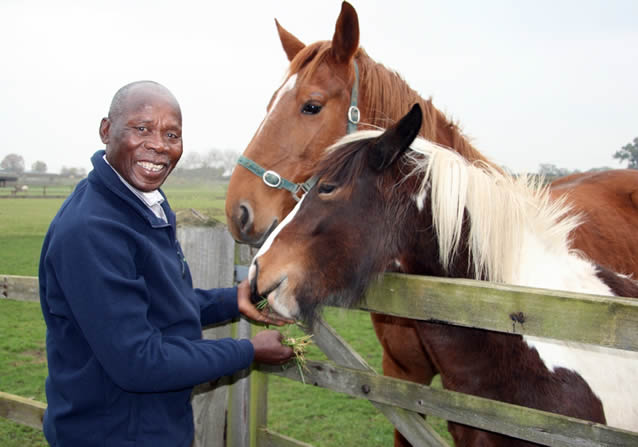
South Africa is mourning the death of pioneering equestrian Enos Mafokate, affectionately known as Kgosi ya Dipere – the King of Horses – and father of veteran kwaito musician Arthur Mafokate.
Mafokate, who was 80, was one of the most important figures in South African equestrian history. He broke racial barriers in a sport that was historically dominated by white competitors and went on to become the country’s first Black showjumper.
His death was confirmed by his family on Thursday.
Family announces his passing
In an official statement, the Mafokate family described the veteran horseman as a beloved husband, father, grandfather, mentor and pioneering South African equestrian.
“It is with profound sadness that the Mafokate family announces the passing of our beloved Enos Mafokate – husband, father, grandfather, great grandfather, mentor and pioneering South African equestrian,” the family said.
“We are deeply saddened by his passing and immensely proud of the extraordinary life he lived and the legacy he leaves behind.”
The family added: “His legacy will live on.”
Details of his memorial and funeral arrangements will be announced in due course.
From stable hand to trailblazer
Mafokate’s journey was one of determination and perseverance.
Born in Alexandra, Johannesburg, in 1944, he developed a passion for horses from a young age. He later worked as a groom and stable hand before getting his opportunity to compete in showjumping.
In 1962, he won his first competition after being given an unexpected opportunity to compete while wearing work overalls and gumboots. His victory marked the beginning of an extraordinary career.
But his biggest challenge was not simply mastering the sport. It was gaining the right to compete.
During apartheid, Black South Africans faced severe restrictions in sport and society. Mafokate fought his way into an equestrian world that had largely excluded Black riders, eventually becoming the first Black South African showjumper to compete alongside white competitors.
His achievements included major victories in South Africa and international appearances in the United Kingdom. He competed at prestigious events in Britain and finished fifth among 31 champions at Wembley, further establishing himself as an international equestrian.
A historic Olympic moment
One of the defining moments of Mafokate’s career came in 1992 when he became part of the South African equestrian contingent at the Barcelona Olympics.
His appearance came at a significant time for South Africa, as the country was emerging from decades of sporting isolation caused by apartheid.
His journey from working as a groom to representing South Africa on one of the world’s biggest sporting stages made him a symbol of what could be achieved despite institutional discrimination.
Mafokate also met Nelson Mandela during the Barcelona Games, adding another historic chapter to a career that had closely followed South Africa’s transition from apartheid to democracy.
Building a legacy in Soweto
For Mafokate, however, his greatest achievement was never only about his own trophies.
He wanted young Black South Africans to have opportunities that had been denied to him.
In 2007, he established the Enos Mafokate Equestrian Centre in Moroka, Soweto, creating a space where children from the township could learn to ride and care for horses. The centre became a training ground for young riders and helped make equestrian sport accessible to communities that had historically been excluded from it.
The centre also became closely associated with his work around animal welfare and youth development. Over the years, Mafokate trained and mentored young riders, with some of his students going on to compete at national and international level.
He remained deeply involved with the centre well into his later years, continuing to spend time with the horses and pass his knowledge to younger generations.
More than Arthur Mafokate’s father
While many South Africans knew Mafokate as the father of Arthur Mafokate, one of the pioneers of South African kwaito, his own contribution to the country stood firmly on its own.
He was a barrier breaker, sportsman, mentor and community builder whose work helped change perceptions about who could participate in equestrian sport.
His career earned him numerous honours, including lifetime achievement recognition and awards for his contribution to South African sport and community development. He was also honoured by the Rand Show and received the Andrew Mlangeni Green Jacket Award.
In 2024, The Citizen described him as a man who had spent decades fostering dreams and championing equality through his work with horses.
A legacy that will outlive him
Mafokate’s story was ultimately about opening doors.
He entered a sport where Black people had been pushed to the margins and refused to accept that horses, showjumping and elite competition belonged to one race.
From Alexandra and Soweto to international arenas, he carved out a place for himself and then dedicated much of his later life to ensuring others could follow.
As his family prepares to lay him to rest, the words in their statement capture the significance of the life he lived: “His legacy will live on.”
And for the generations of riders who learned from him, the young people who found a place at his equestrian centre and the South Africans who saw him break barriers on horseback, that legacy is already firmly established.
